Must I Write?
chronicles of becoming

There’s this thing that happens when you’re 22 and everyone keeps asking what you’re going to do with your life and you get annoyed because you’re also asking yourself the same question, though more often and thoughtfully, while finishing an assignment you did not finish before because you were doing more important things that will lead you to a more meaningful life.
I found a copy of Letters to a Young Poet hidden in my files last week. I wasn’t looking for it. I was looking for a PDF on India’s economic landscape because I had a paper due, but then I found this file misshelved in the wrong place. If it was physical copy, I imagine it would have a forest green cover. So just imagine I found a hardcover book with a forest green cover. And that I opened said book.
“You ask whether your verses are any good.”
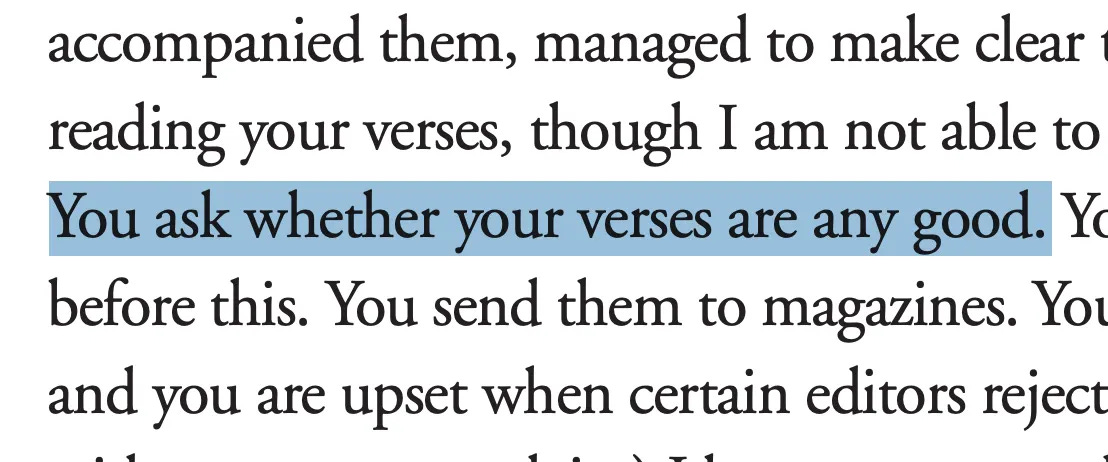
That’s how Rilke starts the first letter. He’s writing to some kid — Franz Xaver Kappus, 19 — who sent him poems and wanted to know if he should be a writer.
[NO. THIS IS NOT AI. LET ME USE MY EM DASHES.]
Rilke says: don’t ask me. Don’t ask anyone. Don’t send your work to magazines. Don’t wait for validation.
“Ask yourself in the most silent hour of your night: must I write?”
I read that line a few times and then I closed the file and checked my phone and I had 47 (I’m making up a number, it was actually more) unread messages scattered across Gmail, Linkedin, and Slack, and someone was asking if I wanted to help them with a project for the spring semester and I said yes immediately even though I didn’t want to because that’s what you do, right? You say yes. You prove you’re useful.
(I still haven’t opened the file again to finish that first letter)
Somebody somewhere once told me that my Linkedin posts are “too personal.” Somebody said I should “create more distance” between myself and the subject matter.
I nodded and said thank you and rewrote this one post to be from the perspective of a hypothetical Brazilian girl at a hypothetical American university and it was worse, obviously, emptier, but maybe somebody, somewhere, liked it better. Why do we try to please other people so much?!
Anyway, Rilke writes: “Don’t write love poems; avoid those forms that are too facile and ordinary.” But then tells you to “describe your sorrows and desires, the thoughts that pass through your mind.”
Which is it? I want to ask him. Do I write what’s easy or what’s real? Do I perform distance or drown in closeness? He’s been dead for almost 100 years so he doesn’t answer.
The thing about reading Rilke at 22 is that he’s telling this kid to be patient, to live in the questions, to not rush toward answers, and I’m sitting here with 28 tabs open (it’s a good day). Patience feels like a luxury I can’t afford.
“Live the questions now,” he says. “Perhaps then, someday far in the future, you will gradually, without even noticing it, live your way into the answer.”
I’m drinking my Winter Latte (small, from Blue Bottle, $(1 arm + 1 kidney)) and thinking about how everyone around me seems to have answers already. They know they’re going into consulting or med school or finance. They network with the confidence of people who believe their lives will unfold in predictable, manageable ways.
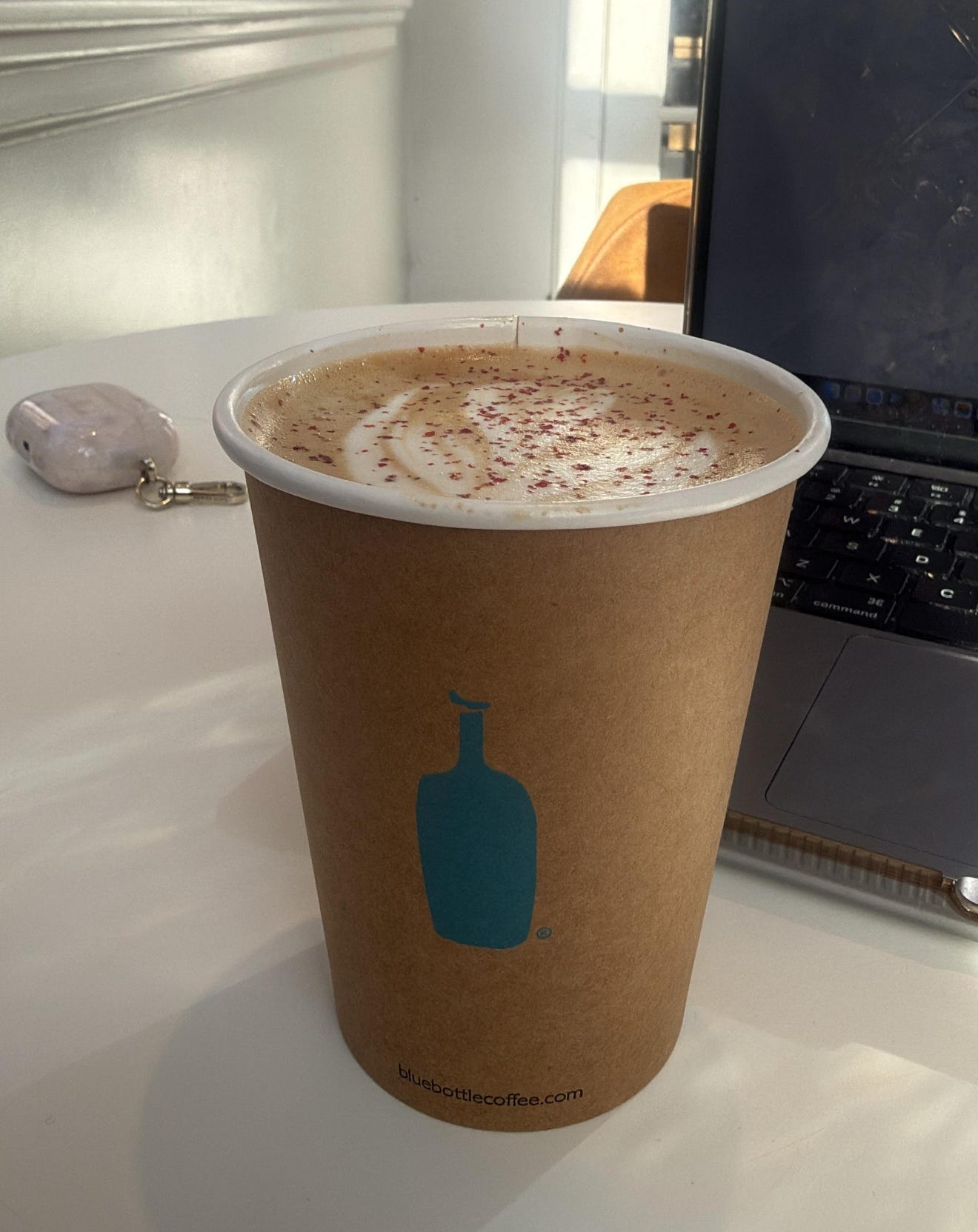
I confess I still have many questions.
Must I write? Must I market? Must I perform certainty when I feel none?
Just kidding. It’s also not like that. I’m being dramatic. I do feel some certainty.
I haven’t finished the book yet, but one thing I know:
What Rilke’s been saying this whole time across a hundred years and an ocean and whatever the distance is between a famous German poet and a 22-year-old Brazilian creative who can’t figure out if she wants to be a marketer or a tech person or a struggling artist is that nobody really knows what they’re doing.
this is scary
Thank you Julia for sharing this.
As someone who’s no longer in her 20s, this resonated deeply. In reality, you never stop having questions or doubts. Sometimes you think you’ve found your path, only to realize it’s not what you expected, so the only way to figure out what comes next is by trying. That’s how you live your way into the answer.